Blue Mountains
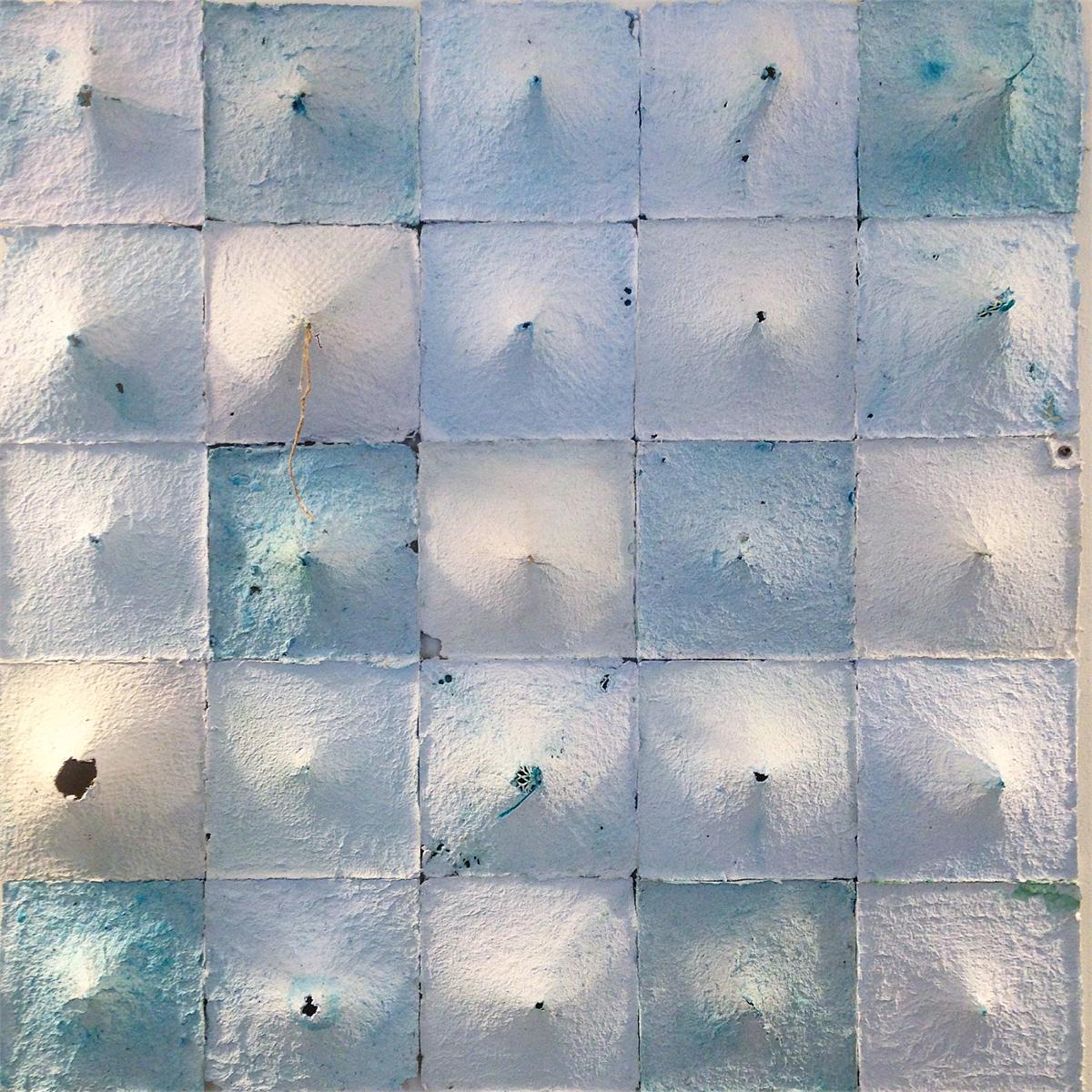
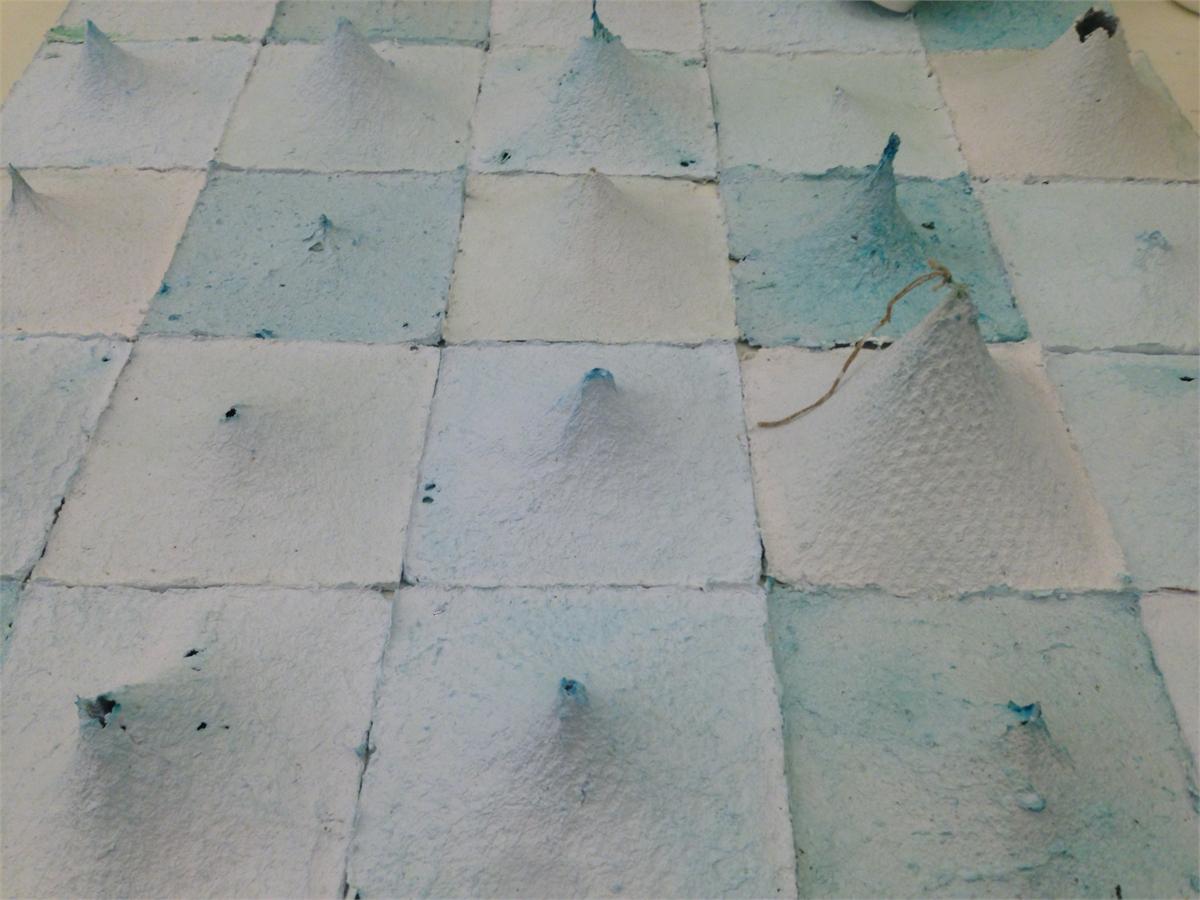

Paper is the cheapest building material there is, and the only one almost everybody throws away. This research asked what happens if you do not leave it flat.
Question
Renovations nearly always throw up the same problem: a large, hard, flat wall that echoes and that you cannot make handsome without putting something expensive against it. Acoustic panels solve the sound but look industrial; plaster looks good but does nothing for the sound. The question was whether one self-made material could do both — and whether it could be made from waste paper.
Method
The tiles are formed from pulp made of shredded print work and old drawings, in a wooden mould of roughly thirty by thirty centimetres. As long as the fibre is wet, the material can be shaped: a cone is drawn upwards out of the centre of each tile with a thread, and the tile is then dried in that position. As it dries the pulp shrinks and pulls itself taut — the cone stiffens, the edges curl up, and the sheet becomes a shell.
No two tiles come out the same. The amount of ink in the source paper determines the colour; what emerged was a range from white to ice blue, speckled with flecks of print work that had not fully broken down. That spread has not been corrected but used: within the grid it makes the surface come alive without introducing a pattern.
What came of it
Hung vertically, the relief does two things at once. The cones break raking light into soft shadows, so that a dull wall gains depth without a single colour being added. And they break the sound: the irregular surface scatters reflections in every direction, which noticeably shortens the reverberation. It is not a product and it never became one. It is on the shelf as a building block, ready for the moment a project calls for it.
Where it came from and where it went
The commission came from MaterialSense, through the Amsterdam Academy of Architecture: find out what can be done with paper. The paper itself came out of the academy's own recycling bin — the material was already there, and only changed shape.
The panel was later shown at Dutch Design Week. One of my tutors fell for it and bought it; it hangs on his wall now.
- Year
- 2017
- Commission
- MaterialSense, through the Amsterdam Academy of Architecture
- Question
- Research into what can be done with paper
- Material
- Paper hand-pulped from the academy's own recycling bin
- Size
- Five by five tiles, about 1 × 1 m in total
- Shown at
- Dutch Design Week, Eindhoven
- Status
- Sold; hangs on the wall of one of my tutors